
By the time Egon Erwin Kisch arrived in Melbourne in 1934, fascism was ascendant in Europe. The Czech-born Jewish journalist had come to address the All-Australian Congress Against War and Fascism, and the conservative government of Joseph Lyons was determined to see him deported.
Officials invoked the dictation test under the Immigration Restriction Act 1901, not in English or Czech, but in Scottish Gaelic, a language so obscure that few could reasonably be expected to pass it. Kisch failed and was declared a prohibited immigrant. While awaiting deportation, Kisch jumped from the vessel onto the wharf, breaking his leg in the process and prompting his immediate arrest
What followed was a months-long legal battle that reached the High Court, which ultimately ruled that the test had been improperly administered. Kisch was allowed to remain. The episode revealed the dictation test for what it was: less a safeguard of standards than an instrument of executive discretion.

If Kisch’s ordeal revealed the machinery of exclusion at work, the eventual dismantling of that apparatus would prove far less dramatic.
Australians might be forgiven for wanting the end of the much-maligned White Australia policy to have arrived with a moment of sombre moral reckoning, or through the decisive courage of a single political leader willing to repudiate decades of racial exclusion. The reality, as so often in Australian political history, was far more prosaic. White Australia did not end in a burst of conscience or condemnation. It was dismantled slowly, bureaucratically, and largely without ceremony.
The policy can only be understood in the context of the racial anxieties of the early twentieth century and the parallel, if often contradictory, project of liberal nation-building that accompanied Federation. Enacted in the first year of the nation’s existence, the Immigration Restriction Act 1901 formed the scaffolding of what would become known as the White Australia policy. It codified racial resentments that ran from the sugar plantations of Far North Queensland to the exhausted goldfields of central Victoria.

The historian Marilyn Lake has been blunt in her assessment of the racial purpose of the Act:
“Its primary purpose was to protect the ‘white man’ (the white male worker) from the degradation and exploitation associated with ‘Asiatic’ or ‘coolie’ labour, as had been used in the Queensland sugar industry and across the British empire following the abolition of slavery.” - Professor Marilyn Lake
The long, lingering decay of White Australia began in the late 1940s, when the nation found itself confronting an acute labour shortage that migration from Britain alone could not resolve. In 1947, the Labor government of Ben Chifley reached agreement with the International Refugee Organization to admit displaced persons from war-ravaged Europe. Over the following five years, more than 170,000 refugees arrived, many legally bound to two-year labour contracts and dispatched to major infrastructure projects across the country.
This was no sudden racial enlightenment, but rather a recalibration of what was, and what was not, considered tolerably white. Baltic peoples, Poles, Ukrainians and Yugoslavs — regarded only years earlier as alien and unassimilable — were now recast as Europeans capable of absorption into the national project.
The next mechanism to fall was the infamous dictation test. The central enforcement device of the 1901 Act, it allowed an immigration officer to require an aspiring entrant to write out a passage of fifty words dictated in any prescribed language. It was less a test of literacy than an instrument of discretion, enabling exclusion without explicit racial reference. By the mid-1950s its use had already diminished, and it was formally abolished by the Migration Act 1958 under the government of Robert Menzies. Its quiet demise removed the most notorious tool of racial exclusion, though not yet the policy’s underlying logic.
If one initiative illustrated the policy’s slow erosion, it was the Colombo Plan, launched in 1950 at the height of the Cold War. Designed to foster regional development and goodwill in South and Southeast Asia, it brought thousands of Asian students to Australian universities throughout the 1950s and 1960s. Officially temporary visitors, these students nonetheless complicated a migration system that still privileged European settlement. For the first time in significant numbers, Australians encountered their Asian neighbours not as labour to be managed, but as classmates, colleagues and future leaders.
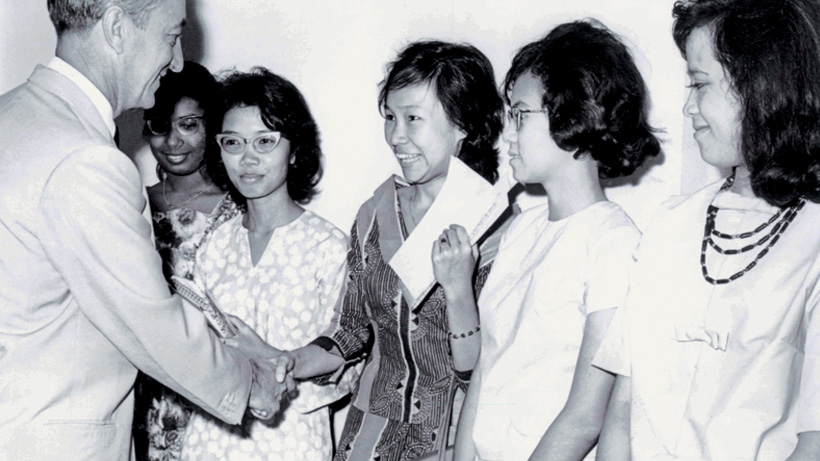
By the mid-1960s, Australia found itself at an immigration crossroads. In March 1966, Prime Minister Harold Holt told Parliament that the government had been “making a review of the restrictive aspects of our immigration policy,” acknowledging that the existing framework no longer aligned with Australia’s growing regional engagement. Holt cited “Australia’s increasing involvement in Asian developments” as justification for reform. Under the new settings, non-European migrants could apply for permanent residence and citizenship on the same basis as Europeans, marking a decisive shift from racial exclusion toward criteria grounded in skills and capacity to settle.
By the time Gough Whitlam came to office in 1972, the White Australia policy was more relic than regime. The dictation test had been abolished, non-European migration was already established, and Asian students had been studying in Australian institutions for more than two decades. What remained was to formalise in law what had already been undone in practice.
In 1973, without fanfare or dramatic parliamentary confrontation, the Whitlam government resolved in cabinet to remove race as a factor in migrant selection, applying uniform criteria to all applicants regardless of origin. Immigration Minister Al Grassby told Parliament that migrant selection would proceed without discrimination on the basis of race, colour or nationality.
With the passage of the Racial Discrimination Act 1975, practices that had once sustained a racially exclusive migration system were rendered not merely obsolete, but unlawful. The White Australia policy did not fall in a single moment of national reckoning. It receded — revised, softened and modernised before finally being erased — until it no longer determined who could become Australian.


