
By the end of the 1940s, Australians were at a crossroads. Since Federation nearly half a century earlier, they had lived awkwardly between worlds: British subjects, politically enfranchised and self-governing, yet not formally citizens of their own country. The fracturing of imperial power that followed the Second World War broke the assumptions on which British belonging had long rested.
In 1948, the Australian Citizenship Act formally severed the automatic link between Australian nationality and British subjecthood. Australians were citizens at last, though who could truly belong remained tightly constrained.
From the late nineteenth century, an emergent Australian identity had begun to define itself in opposition to British values. As historian Marilyn Lake has argued, British society was shaped by class hierarchy, hereditary privilege, and the subjugation of women. In contrast, Australian values found expression in new laws and institutions that emphasised political equality, including manhood and womanhood suffrage, alongside the Commonwealth Conciliation and Arbitration system. It was in the realm of citizen rights—above all the franchise—that Australian belonging most clearly diverged from British subjecthood.
Since the passage of the Immigration Restriction Act in 1901, which established the White Australia policy, Australia had wrestled with its racial identity. Anti-Chinese sentiment, entrenched since the gold rushes of the 1850s, had erupted into violence on the diggings and informed a patchwork of colonial restrictions well before Federation. The Act did not resolve these tensions. Instead, it consolidated them, transforming local prejudice into federal policy and embedding racial exclusion in early Australian law.
As Lake observes, the policy’s primary purpose was to protect the “white man”—specifically the white male worker—from what was seen as the degradation associated with “Asiatic” or “coolie” labour in Queensland’s sugar industry and across the empire following the abolition of slavery.
While anti-Chinese sentiment festered in the southern colonies, the exploitative use of Pacific Islander labour in Queensland generated a separate and equally potent anxiety. From the 1860s, tens of thousands of Pacific Islanders were transported through the Kanaka labour system to Australia’s tropical north to serve the growing sugar industry. Using coercive and deceptive practices later known as blackbirding, the system provoked widespread alarm. As The Bulletin declared in 1893, “there is no room for two races under one flag,” reflecting a belief that racialised labour threatened the future of a white, wage-earning nation.
The question of who was and was not Australian often appeared self-evident. If one was white, British, and settled, there was little perceived need for citizenship as a legal category. Belonging was understood racially, and the exclusion of outsiders was not regarded as a problem requiring remedy.
If any doubt remained about the national image of a white Australia, the horrors of the First World War and the Anzac mythology that followed helped to settle it. Australia’s British inheritance was reinforced in the national story, along with assumptions of ethnic homogeneity that rendered citizenship unnecessary for those already deemed to belong.
In the context of citizenship and political rights, perhaps no single fact better captures the moral obscenity of the war than this: hundreds of thousands of British men were conscripted to fight and die in northern France before they had secured full suffrage at home, while their Australian counterparts—serving on a strictly voluntary basis—had enjoyed full adult male suffrage since 1902. Australian men and women twice exercised those rights in 1916 and 1917, voting to defeat proposals for compulsory military service in life-and-death national referendums.
During the interwar years, these assumptions largely held, reinforced by imperial continuity and restrictive immigration controls.
The Second World War delivered the decisive rupture. Australia’s strategic dependence on Britain collapsed as Japanese forces advanced through the Pacific and imperial protection failed to materialise. Australians increasingly fought alongside American forces, underscoring how far old assumptions of imperial power and security had eroded.
The end of the fighting in 1945 ushered in a transformed world. No longer a distant imperial outpost buffered by geography and empire, Australia faced acute labour shortages and the prospect of rapid demographic change as mass displacement reshaped the global order. The equation of whiteness with belonging began to strain under pressures it could no longer contain.
Immigration Minister Arthur Calwell’s call to “populate or perish” captured the urgency of the moment. Migration was framed less as a pathway to belonging than as a question of national survival. An initial influx of British migrants briefly sustained hopes that reconstruction could proceed without challenging the racial status quo. That assumption quickly collapsed.
By the late 1940s, labour shortages forced a cautious turn toward non-British migrants. In 1947, Australia entered agreements with the International Refugee Organization to accept displaced Europeans under compulsory two-year labour contracts. The scheme brought 170,000 people to Australia over five years, meeting workforce needs while tightly regulating settlement and movement.
For those admitted, citizenship did not confer immediate equality. Acceptance was conditional, governed by expectations of work, conduct, and conformity. Migrants were channelled into labour-intensive nation-building projects such as the Snowy Mountains Hydro-Electric Scheme, where non-British Europeans were often assigned the hardest and most remote work.
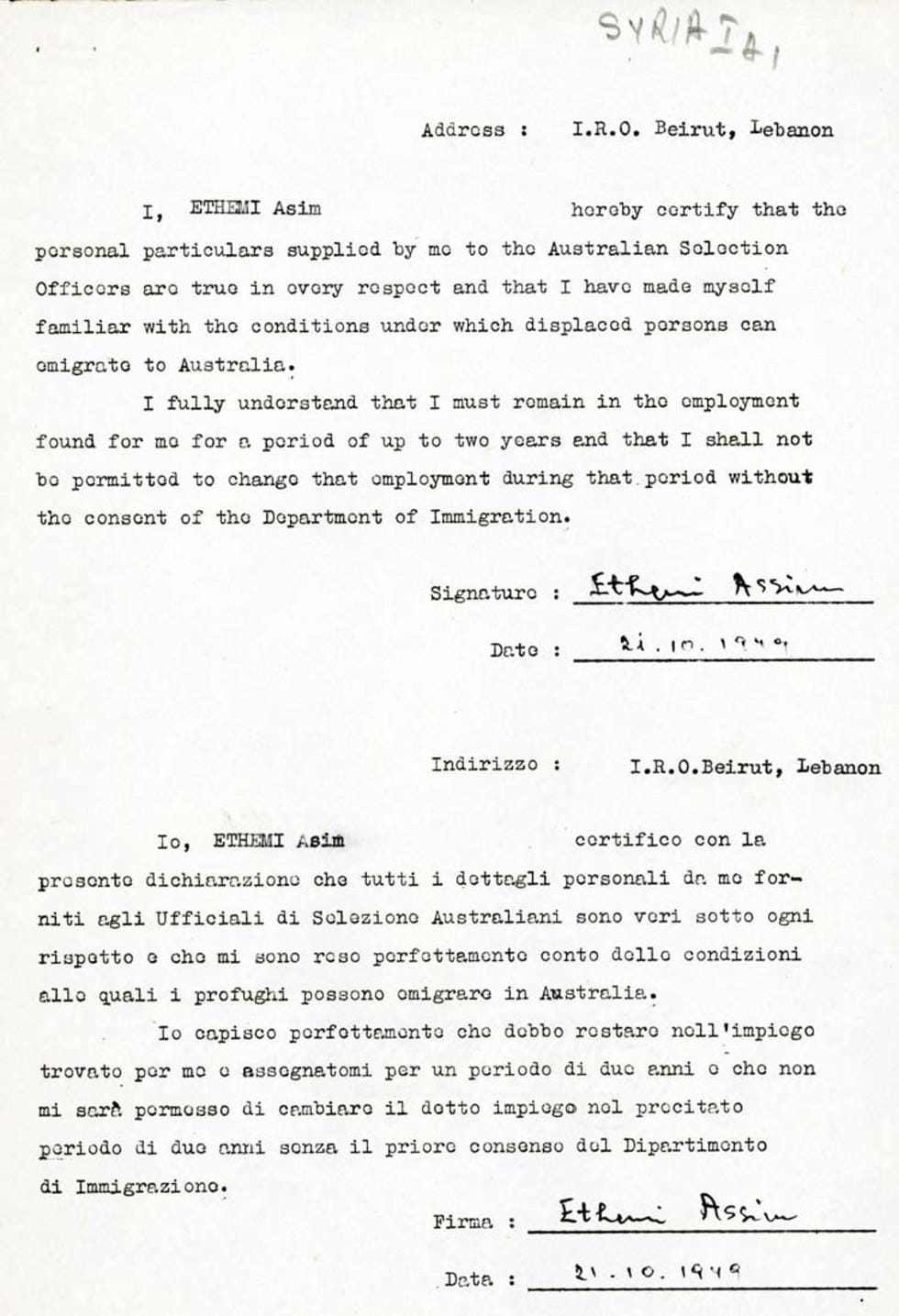
Resentment followed. The term “Balt” emerged as a pejorative directed at displaced persons from the Baltic states and central Europe, revealing the limits of social acceptance despite formal inclusion.
It was in this context—of growing reliance on migrant labour previously excluded from full belonging—that Australian citizenship was formally enacted in 1948. While citizenship promised legal equality on paper, many migrants remained subject to controls over where they worked, lived, and formed communities until contractual obligations were fulfilled.
The limits of citizenship were even more starkly exposed in its application to Indigenous Australians. While newcomers were incorporated, however conditionally, Indigenous Australians remained largely excluded from the practical substance of citizenship. They were omitted from the census, denied full political participation in many jurisdictions, and subjected to extensive state controls over movement, employment, family life, and property.
Incremental change followed. The Commonwealth Electoral Act 1962 extended federal voting rights to Indigenous Australians, though enrolment remained uneven. The 1967 referendum brought Indigenous Australians into the national census and expanded Commonwealth powers, altering constitutional recognition without dismantling the systems of control shaping daily life.
The dismantling of the Immigration Restriction Act in 1958, the gradual erosion of the White Australia policy, and initiatives such as the Colombo Plan further reshaped belonging. By bringing Asian students into Australian universities, the Plan marked a quiet but profound break with the racial assumptions of White Australia. For many Australians, sustained contact with educated, middle-class Asians challenged inherited prejudices in ways legislation alone had not.
Australian citizenship today bears little resemblance to the narrow, conditional status it assumed at inception. What emerged in 1948 was not a universal promise of equality, but a legal mechanism shaped by race, labour demand, and bureaucratic control.
Over time, political pressure, migration, and sustained challenge reshaped that framework. The dismantling of racially discriminatory policies, the gradual extension of political rights to Indigenous Australians, and the adoption of multiculturalism transformed Australian citizenship from a tool of exclusion into a more expansive, non-discriminatory civic ideal—one that remains an unfinished project, continually testing Australia’s commitment to its own democratic principles.
This article will be updated with archival images and maps as permissions are secured.


